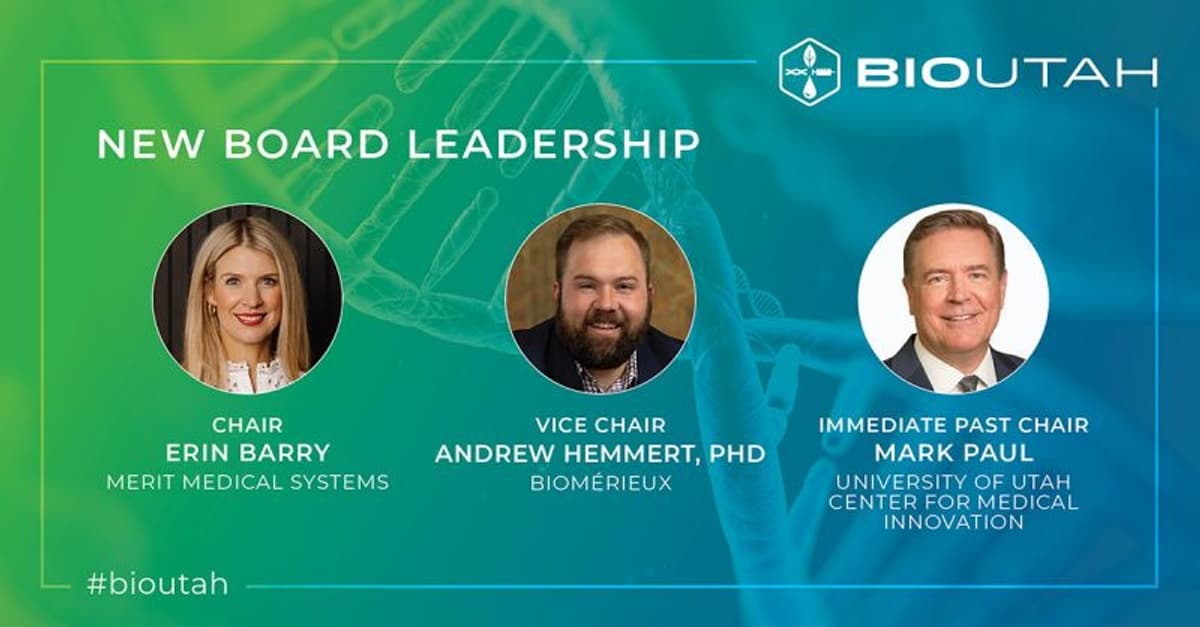
BioUtah, Utah's trade association serving the state's life sciences community, has announced significant leadership changes and new board appointments that will shape the organization's direction through 2026. Erin Barry, vice president of government affairs for Merit Medical Systems, will assume the role of board chair effective January 1, 2026, while Andrew Hemmert, PhD, senior vice president of molecular research and development for bioMérieux, will serve as vice chair. Barry succeeds Mark Paul, executive director of the Center for Medical Innovation at the University of Utah, who will remain on the board as immediate past chair and executive committee member.
The implications of this leadership transition are substantial for Utah's innovation ecosystem. Barry's expertise in government relations at Merit Medical Systems, where she oversees all local, state, and federal government relations and directs lobbying efforts on critical issues such as taxation, international trade and tariffs, FDA regulation, and economic incentives, positions BioUtah to more effectively advocate for favorable policies. This governmental advocacy capability is crucial for an industry heavily regulated by entities like the FDA and impacted by international trade policies. Simultaneously, Dr. Hemmert's scientific leadership at bioMérieux, where he leads global teams focused on developing easy-to-use, rapid, and comprehensive diagnostic solutions including innovations in infectious disease diagnostics and the SpotFire system for point-of-care settings, ensures the organization's strategic direction remains grounded in cutting-edge scientific advancement. This dual-focus leadership suggests BioUtah is adopting a comprehensive strategy to nurture the sector's growth from both regulatory and innovation standpoints.
The leadership changes coincide with the immediate appointment of three new board members: Jim Fitzgerald, CEO of ATL Technology; Tracy George, MD, chief scientific officer and president of the Innovation Business Unit at ARUP Laboratories; and Chris Lowe, CEO of Nusano. Fitzgerald brings over 15 years of executive leadership in medical device and packaging, Dr. George contributes extensive expertise in laboratory diagnostics and clinical trials alongside her academic role, and Lowe offers more than 30 years of business experience with strength in strategic direction, licensing, and acquisitions. The expansion of the board with this diverse expertise broadens BioUtah's capacity to address the multifaceted challenges of the life sciences industry, which encompasses medical device manufacturing, research and testing, biotechnology, biopharmaceuticals, and diagnostics. The departure of two members after eight years of service and adjustments to the executive committee refresh the governance structure, which now comprises 16 directors.
These strategic moves are important because they signal BioUtah's proactive stance in strengthening Utah's position within the competitive national life sciences landscape. By combining deep policy experience with scientific and business leadership, the organization is better equipped to foster an environment conducive to innovation, investment, and job creation. For stakeholders, this governance evolution promises more robust advocacy on issues affecting business viability and a clearer channel for translating scientific discovery into commercial and clinical success. The organization's activities and governance structure can be explored further at https://www.bioutah.org.